🚨 “If the Dollar Loses Power, Your Money Loses Value”: The BRICS Shift Most Americans Are Ignoring
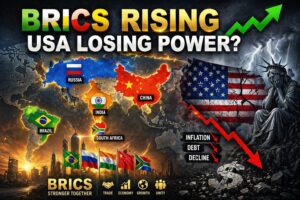
You Won’t See This Coming — But You’ll Feel It Reason BRICS Country
Most financial crises announce themselves.
The headlines get loud.
Markets panic
People react.
This one won’t.
It’s quieter than that.
And that’s exactly why it’s more dangerous
Because if the U.S. dollar slowly loses power — not crashes, not collapses, just weakens — your money doesn’t disappear overnight
It simply buys less.
A little less this year.
A little more next year.
Until one day you realize
👉 Your savings didn’t grow — they shrank in real value.
And the worst part?
Most people won’t even notice it happening.
The Dollar Is Still King — But Something Has Changed
Let’s be clear before we go any further.
The U.S. dollar is still the most powerful currency in the world.
No serious analyst is saying otherwise.
Right now:
- Around 58% of global foreign exchange reserves are still held in U.S. dollars
- Nearly 88% of all currency transactions involve the dollar
- Over 50% of global trade is invoiced in USDThat’s dominance.
But here’s the part that doesn’t get enough attention:
That dominance is slowly slipping.
Back in 2000, the dollar made up over 70% of global reserves.
Today, it’s closer to the mid-50s.
That’s not a crash.
👉 It’s a trend.
And trends are what quietly reshape the future.
Here’s What Most People Get Wrong About BRICS
“BRICS is launching a new currency.”
“The dollar is finished.
That’s not true.
There is no BRICS currency — at least not yet.
So what’s really happening?
This is where it gets interesting.
BRICS countries aren’t trying to replace the dollar overnight.
They’re doing something much smarter:
👉 They’re slowly reducing their need for it.
Trading in local currencies
Settling energy deals outside USD
Building alternative financial systems
This isn’t a revolution.
It’s a quiet shift.
And quiet shifts are the ones people miss — until they’re too big to ignore.
The Real Pressure Point: America’s $39 Trillion Debt
Now here’s the number that should make you pause.
👉 The U.S. national debt has crossed $39 trillion.
That’s not just a statistic.
It’s a system that depends on one thing
👉 Global demand for dollars.
As long as countries hold and use dollars, the U.S. can borrow cheaply and operate normally.
But if that demand starts to fall?
Even slightly?
Everything changes.
- Borrowing gets more expensive
- Interest payments increase
- Economic pressure builds
This is where the BRICS shift matters.
Not because it destroys the dollar.
But because it slowly reduces demand for it.
And when demand drops — even a little — the system feels it.
This Isn’t a Future Scenario — It’s Already Happening
This is where most people underestimate what’s going on.
Because it doesn’t feel dramatic.
But look closer.
Russia now conducts the vast majority of its trade with China and India without using the dollar.
China is increasingly settling oil and gas deals in yuan.
BRICS institutions are pushing for more local currency lending.
These are not small changes.
👉 They are early signs of a system adjusting itself.
Not collapsing.
Adjusting.
So What Happens Next? (This Is Where It Gets Serious
Let’s remove the hype and talk reality.
No, the U.S. economy is not going to collapse overnight.
But that doesn’t mean nothing changes.
1. Inflation Doesn’t Go Away Easily
If the dollar weakens, imports get more expensive.
Energy, goods, supply chains — everything costs more.
Not suddenly.
But consistently.
And that’s how inflation becomes a long-term problem.
2. Interest Rates Stay Higher
If global demand for U.S. debt declines:
👉 The U.S. has to offer higher interest rates to attract buyers.
That affects
- Mortgages
- Credit
- Business expansion
Which slows down economic growth.
3. Markets Become Less Stable
The U.S. stock market thrives on global capital.
If some of that capital starts moving elsewhere:
👉 Volatility increases.
Not necessarily crashes.
But more uncertainty.
Now Let’s Make It Personal — Because This Affects You
This isn’t just about governments or global systems.
It’s about your life.
Your Cost of Living
A weaker dollar doesn’t show up as a headline.
It shows up in your daily life
- Groceries cost more
- Gas prices rise
- Everyday expenses increase
Your Income and Job Stability
When borrowing gets expensive, companies adjust.
Hiring slows.
Wage growth slows.
Risk-taking slows.
Your Investments
If your entire portfolio is tied to one system — one currency — one market…
👉 You are exposed.
And most people are
But Here’s the Other Side (And It Matters)
Before you panic — don’t.
Because there’s something important to understand
The Dollar Isn’t Going Anywhere Anytime Soon
Despite all this
👉 The dollar still has a massive advantage.
There is no real alternative yet.
BRICS is not a unified system.
- China dominates economically
- India and China have tensions
- Political systems don’t align
And most importantly
👉 The Chinese yuan is not fully trusted globally.
It’s controlled.
It’s not freely convertible.
And trust is everything in global finance.
Even U.S. Leaders Are Paying Attention
Even in political discussions, leaders — including Donald Trump — have emphasized the importance of keeping the dollar strong.
Because they understand something most people don’t:
👉 Losing dominance doesn’t look like collapse.
It looks like slow erosion.
And erosion is harder to fight — because people ignore it.
The Most Likely Outcome (No Hype, Just Facts)
Let’s simplify everything.
What’s Most Likely
The dollar stays dominant — but less dominant.
What’s Possible
A more balanced global system emerges.
What’s Unlikely
A sudden collapse of the dollar.
👉 This is not a crisis story.
👉 It’s a transition story.
Where Smart Money Is Already Moving
The smartest investors aren’t waiting for headlines.
They’re watching trends.
Gold Is Getting Attention Again
Not because it’s exciting.
Because it’s stable.
Global Diversification Is Increasing
Money is no longer concentrated in one place.
Flexibility Is Becoming Power
Cash, liquidity, and optionality matter more than ever.
The Risk Nobody Talks About
Here’s the real danger.
It’s not collapse.
👉 It’s complacency.
If the dollar slowly loses power
- You won’t notice immediately
- But your purchasing power will decline
And by the time you realize it…
Adjusting becomes harder.
Final Thought: This Is About Awareness, Not Fear
The United States is not going to fall apart.
It will remain one of the most powerful economies in the world.
But the level of financial dominance it once had?
That may change.
And understanding that early is what gives you an advantage.
🔥 Final Line
The next decade won’t decide if America survives.
👉 It will decide how much of its financial power it keeps.
Knowledgeable 😍
Best knowledge for this article