🧨 Is a 2008-Style Crash Coming for US Stocks in 2026?
THE DAY THE MARKET DIDN’T FEEL RIGHT
Monday morning.
You wake up, grab your phone… and instinctively open your portfolio.
For a second, everything looks normal.
Then you notice it.
Red.
Not just one stock. Not just a sector.
Everything.
The is slipping again. Futures were already weak overnight, but now the sell-off is spreading. The same mega-cap names that carried the market higher for months are suddenly under pressure.
And this time… it feels different.
—
You switch to the news.
“Markets turn volatile…”
“Investors grow cautious…”
“Rate concerns return…”
At first, it sounds like routine noise.
Markets go up. Markets pull back. That’s normal.
But then you notice something unusual.
The tone is changing.
Not panic yet — but tension.
A kind of quiet uncertainty.
—
You scroll further.
Search trends are spiking:
– “Stock market crash 2026”
– “Should I sell my stocks now?”
– “Is a recession starting?”
Social media is worse.
Some investors are calling this a buying opportunity. Others are warning that something much bigger is building beneath the surface.
And then you see the comparison.
Again.
«“This feels like 2008…”»
—
That’s when it hits differently.
Because the last time that sentence started trending — before fear fully took over — was right before the .
Back then, everything looked strong.
The market was rising.
Housing was booming.
Banks were “stable.”
Until suddenly… they weren’t.
—
Here’s what most people forget:
In early 2007, there was no panic.
There were no clear warnings screaming “crisis.”
Just small cracks.
– A few missed mortgage payments
– A few weak earnings reports
– A few “temporary” concerns
Nothing that felt system-breaking.
Until those small cracks connected.
And when they did…
The system didn’t bend.
It broke.
—
Now fast forward to today.
The market is once again near record highs.
But look closer:
– Valuations are stretched
– Interest rates are still elevated
– Debt levels are higher than ever
– A handful of companies are driving most of the gains
On the surface, it looks like strength.
Underneath, it looks like pressure.
—
And here’s the uncomfortable truth:
«Markets don’t collapse because of one big event.»
They collapse when pressure builds quietly…
and then something small triggers something big.
—
Right now, we’re not in a crash.
We’re in something more dangerous.
A phase where:
– Everything still looks okay
– But risks are slowly stacking up
The kind of phase most investors ignore…
Because nothing has gone wrong — yet.
—
So the real question isn’t:
“Is the market falling today?”
Because short-term moves don’t matter.
The real question is:
Are we once again underestimating a risk that’s already building?
—
Because what happens next won’t just decide market direction.
It will decide something much more important:
Whether this moment becomes just another correction…
Or the early stage of something far more serious.
—
And just like before…
Most people won’t realize it until it’s already happening.
🌍THE MARKET LOOKS STRONG — UNTIL YOU LOOK CLOSER
If made you uneasy… good.
Because the real story of this market isn’t visible at the surface.
On the surface, everything looks fine.
Strong, even.
But markets are rarely dangerous when they look weak.
They become dangerous when they look too strong to fail.
—
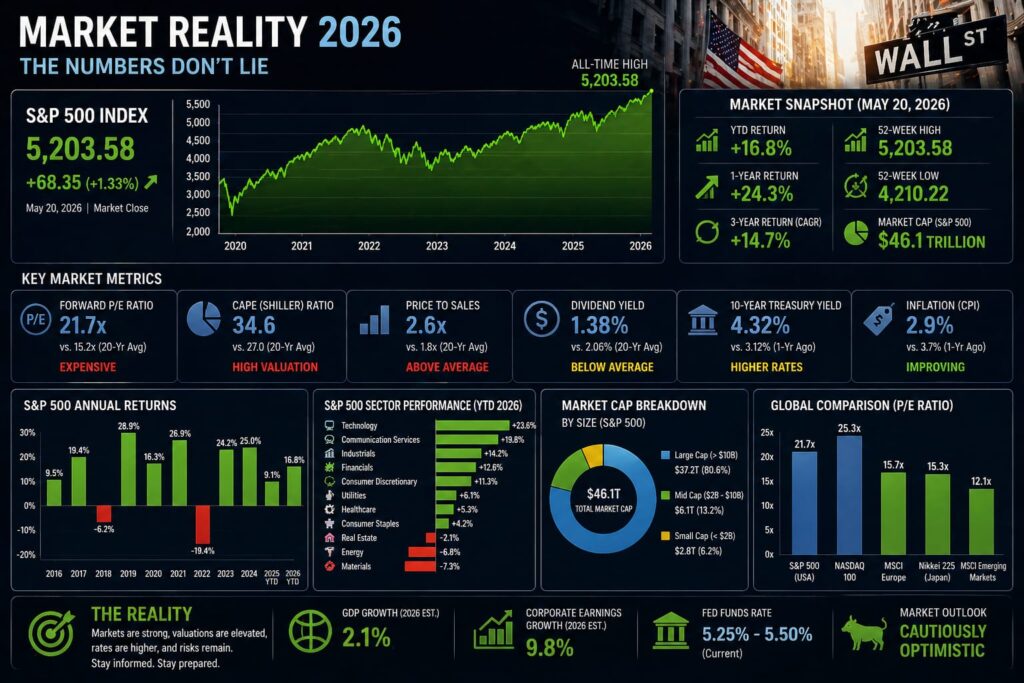
📊 THE NUMBERS THAT MAKE THIS MARKET LOOK UNSTOPPABLE
The is trading near all-time highs.
Let’s break that down:
– 2024 return: ~+25%
– 2025 return: ~+17–18%
– 2026 levels: ~7,150–7,180 range
– Year-over-year gain: ~+28%
On paper, this is exactly what a healthy bull market looks like.
Strong returns.
Stable momentum.
Consistent buying interest.
If you stop here…
there is no crisis.
—
⚡ But Here’s the Problem
Those numbers don’t tell you how the market is rising.
And that’s where things start to change.
—
⚠️ THE HIDDEN STRUCTURE: A MARKET DRIVEN BY A FEW
This rally is not broad.
It’s concentrated.
A small group of mega-cap companies — largely tied to AI and technology — are responsible for a disproportionate share of the gains.
In fact:
– Top tech leaders have contributed 30–40% of total index gains
– Many mid-cap and small-cap stocks are flat or underperforming
That creates a fragile dynamic:
«When a few stocks carry the entire market…
the entire market depends on them not falling.»
—
🧠 Why This Matters
This is called a narrow market rally.
And historically:
– Late 1999 (dot-com bubble) → narrow leadership
– Late 2007 (pre-financial crisis) → narrow leadership
In both cases:
The index looked strong.
But underneath…
the market was already weakening.
—
📈 VALUATIONS ARE FLASHING WARNING SIGNALS
Now look at pricing.
This is where things start getting uncomfortable.
– Forward P/E ratio: ~22×
– CAPE ratio: ~30
Compare that to history:
– Long-term average P/E: ~16×
– Pre-2008 P/E: ~15–17×
– 2000 bubble peak: ~24×
That tells us one thing clearly:
«This market is not cheap.
It’s expensive — by historical standards.»
—
⚠️ Why Expensive Markets Are Dangerous
When valuations are high:
– Good news is already priced in
– Expectations are elevated
– Margin for error disappears
Which means:
Even a small negative surprise can trigger a large reaction.
—
💸 THE REAL FORCE: INTEREST RATES
Now we come to the most important driver of this entire environment:
Over the last cycle:
– Rates were pushed up to 5.25–5.50%
– Currently (2026): still around 3.5–3.75%
For context:
– 2006 peak rate: ~5.25%
We are once again in a high-rate environment.
—
⚡ Why This Changes Everything
High interest rates affect the system in multiple ways:
– Borrowing becomes expensive
– Corporate margins shrink
– Consumer spending slows
– Asset valuations compress
In simple terms:
«Higher rates = lower future growth expectations»
And when growth expectations fall…
markets eventually adjust.
—
💧 LIQUIDITY IS QUIETLY DISAPPEARING
Now here’s the part most retail investors don’t see.
During 2020–2021
– The Fed injected massive liquidity
– Balance sheet expanded to ~$9 trillion
– Money was cheap and abundant
That liquidity fueled:
– Stock market rallies
– Crypto booms
– Risk-taking behavior
—
⚠️ Now Look at Today
The environment has flipped:
– Balance sheet reduced to ~$7.5–8 trillion
– Quantitative tightening (QT) ongoing
– Liquidity is being drained
This is critical.
Because:
«Markets don’t crash when liquidity is high.
They weaken when liquidity is pulled out.»
—
🧠 This Is the Silent Risk
Liquidity doesn’t disappear overnight.
It fades slowly.
And during that phase:
– Markets still rise
– Confidence still exists
But the foundation…
gets weaker.
—
🤖 THE AI BOOM — POWERFUL, BUT RISKY
Another major factor behind this rally:
Artificial Intelligence.
AI has driven:
– Earnings optimism
– Massive capital flows
– Valuation expansion
And yes — the opportunity is real.
But here’s the concern:
«The expectations may be running ahead of reality.»
—
⚡ We’ve Seen This Pattern Before
– 2000: Internet revolution (real innovation, overhyped valuations)
– 2008: Housing expansion (real demand, excessive leverage)
Today:
– AI = real transformation
– But valuations = aggressive
📊 THE DEBT FACTOR (THE MOST UNDERAPPRECIATED RISK)
Now let’s talk about something even bigger than valuations:
Debt.
Current system:
– US government debt: $38–39 trillion
– Debt-to-GDP: ~101%
– Consumer debt: ~$18 trillion
– Corporate debt: $10–11 trillion
Compare that to 2008:
– Debt-to-GDP: ~60–70%
—
💣 Why This Is Critical
Debt itself is not the problem.
The problem is:
«Debt + high interest rates»
Because that creates:
– Higher repayment pressure
– Increased default risk
– Financial system stress
—
🧠WHAT SMART MONEY IS S EEING RIGHT NOW
Professional investors are not panicking.
But they are adjusting.
Because they see this combination:
– High valuations
– High debt
– Tight liquidity
– Concentrated market structure
Individually, manageable.
Together?
👉 A fragile system.
—
⚡ THE SIMPLE TRUTH (NO NOISE)
Let’s simplify everything:
– The market is strong ✔
– The structure is weak ⚠️
– The risks are building slowly ⏳
—
💣 And This Is the Most Important Line in This Entire Section:
This is exactly how risk builds — quietly, gradually, and unnoticed.
—
Because markets don’t collapse overnight.
They weaken beneath the surface first.
And by the time most investors notice…
the move has already begun.
—
🔥 NOW THE QUESTION EVOLVES
It’s no longer:
👉 “Is the market going up?”
Now it becomes:
«How sustainable is this strength… under pressure?»
—
Because what comes next…
won’t depend on momentum.
It will depend on whether the system can absorb stress —
or finally react to it.
—
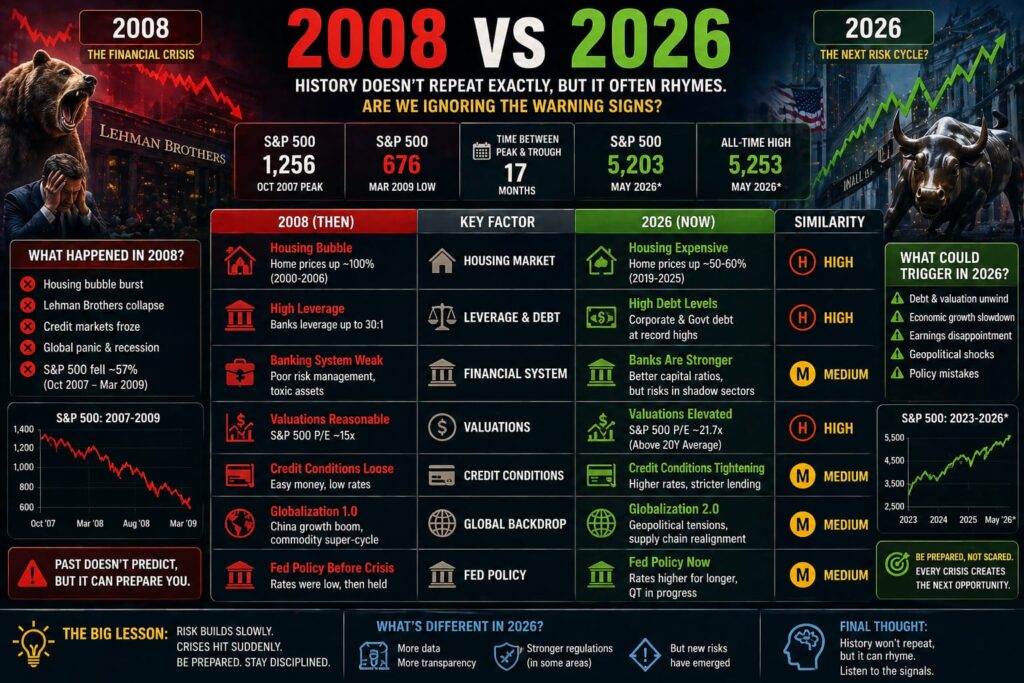
📉 2008 vs TODAY — THE DATA-DRIVEN TRUTH MOST INVESTORS MISS
By now, the pattern is clear:
The market is strong… but uneasy.
The system is stable… but under pressure.
And naturally, the comparison keeps coming back:
But here’s the critical mistake most investors make:
«They compare headlines… not structure.
They compare fear… not data.»
So let’s do this properly.
Not emotionally.
Factually.
—
🧨 PART A: WHAT ACTUALLY CAUSED THE 2008 COLLAPSE
The 2008 crisis didn’t begin in the stock market.
It began in one place:
👉 Housing.
—
🏠 The Housing Bubble (2000–2006)
Between 2000 and 2006:
– US home prices surged nearly ~100%
– Mortgage lending expanded aggressively
– Subprime loans (high-risk borrowers) exploded
Banks weren’t just lending.
They were packaging these loans into complex securities and selling them globally.
—
💣 The Leverage Problem
Here’s where things became dangerous:
– Major banks operated with leverage ratios as high as 30:1
– That means even small losses could wipe out capital
At the same time:
– Risk was hidden inside mortgage-backed securities
– Investors believed these assets were safe
—
⚠️ The Trigger
Then came the turning point:
– Mortgage defaults began rising
– Housing prices started falling
– Those “safe” assets lost value rapidly
—
🏦 System Breakdown
Confidence collapsed.
Credit markets froze.
And once trust disappeared…
the entire system unraveled.
—
📊 The Outcome (Data)
– S&P 500 fell nearly ~50%
– US housing dropped ~25–30%
– Unemployment surged toward ~10%
—
👉 Key takeaway:
2008 was not just a correction.
It was a system-wide failure driven by leverage + housing risk + weak banks.»
—
⚖️SIMILARITIES — WHY THE COMPARISON EXISTS
Now let’s look at today.
Not emotionally — structurally.
—
💸 1. Debt Levels Are Even Higher
Today’s system:
– US government debt: $38–39 trillion
– Debt-to-GDP: ~101%
– Consumer debt: ~$18 trillion
– Corporate debt: $10–11 trillion
2008 system:
– Debt-to-GDP: ~60–70%
—
👉 Insight:
«The system today is more leveraged than it was before the 2008 crash.»
—
📈 2. Valuations Are Elevated Again
Current market:
– Forward P/E: ~22×
– CAPE: ~30
Pre-2008:
– P/E: ~15–17×
—
👉 Insight:
«Expectations today are significantly higher — and more fragile.»
—
💧 3. Liquidity Sensitivity
2008 setup:
– Easy credit fueled growth
Today:
– Tight credit is slowing growth
Different direction — same impact.
Because:
«Changes in liquidity drive market behavior.»
—
🧠 4. Investor Psychology
Every cycle has a dominant narrative.
– 2008 → “Housing always goes up”
– 2026 → “AI will drive unlimited growth”
—
👉 Insight:
«Strong narratives often justify high valuations — until they don’t.»
—
⚠️ 5. Early Warning Signals Exist Again
Then and now:
– Some experts are cautious
– Most investors remain optimistic
That’s how late-cycle environments behave.
—
👉 Conclusion:
«The fear is not irrational.
There are real structural similarities.»
—
🔍 DIFFERENCES — WHY THIS IS NOT A COPY OF 2008
Now comes the most important part.
Because similarities create fear.
Differences create clarity.
—
🏦 1. Banks Are Significantly Stronger
Today:
– CET1 capital ratio: ~12.8%
– Tier 1 capital: ~14.4%
– Stress tests show ability to absorb $550B+ losses
2008:
– Much lower capital buffers
– High leverage
– Weak risk controls
—
👉 Insight:
«The banking system today is far more resilient.»
—
📜 2. Regulation Is Much Tighter
Post-2008 reforms introduced:
– Higher capital requirements
– Liquidity coverage rules
– Annual stress testing
The system is now:
👉 More transparent
👉 More controlled
—
🏠 3. Housing Structure Is Different
Today:
– Mortgage rates: ~6–6.5%
– Lending standards stricter
– Borrowers stronger
2008:
– Subprime dominance
– Weak underwriting
—
👉 Insight:
«Housing is expensive today — but not built on the same fragile foundation.»
—
💼 4. Economic Structure Has Shifted
Today’s economy is driven by:
– Technology
– Services
– Innovation
2008 economy:
– Heavily dependent on housing and finance
—
👉 Insight:
«Risk is more distributed across sectors today.»
—
💰 5. Central Banks Are More Prepared
The today:
– Has crisis experience
– Uses advanced tools
– Acts faster during stress
—
👉 Insight:
«Policy response capability is stronger than in 2008.»
🧠 FINAL TRUTH (THE MOST IMPORTANT SECTION)
Let’s simplify everything into one clear comparison:
– 2008 = System collapse
– 2026 = System under pressure
That difference matters.
A lot.
—
⚡ Where the Real Risk Comes From
Not from one factor.
But from a combination:
– High debt
– High valuations
– Tight liquidity
– External shocks
Individually manageable.
Together?
👉 Potentially unstable.
—
💣 What Actually Triggers a Crisis?
Conditions don’t cause crashes.
Triggers do.
Examples:
– Credit market disruption
– Corporate default wave
– Sharp economic slowdown
– Geopolitical shock
—
👉 Insight:
«A stressed system + a trigger = crisis potential»
—
🔥 THE QUESTION HAS NOW EVOLVED
It’s no longer:
👉 “Is this exactly like 2008?”
The real question is:
«If something breaks…
is the system strong enough to absorb it?»
—
Because that answer determines everything:
– A correction
or
– A crisis
—
And right now…
we’re in the phase where that answer is still uncertain.
—
💥 RISK, SCENARIOS & HOW SMART INVESTORS ARE POSITIONING RIGHT NOW
At this point, the picture is clear:
– The market is strong ✔
– The system is stressed ⚠️
– Risk is building beneath the surface ⏳
Now we move to the most important part:
What actually happens next — and what should investors do about it?
Because this is where outcomes are decided.
Not by prediction…
but by positioning.
—
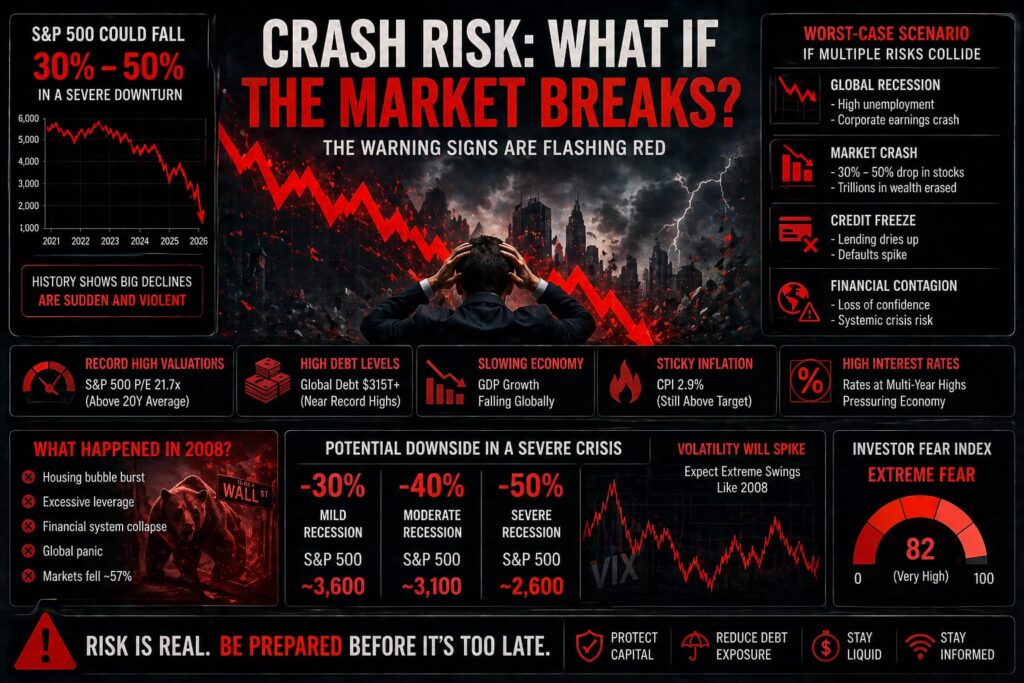
⚠️ THE REAL RISK SIGNALS (DATA + REALITY)
Let’s strip away noise and focus on what actually matters.
These are not opinions.
These are structural signals.
—
💣 1. THE DEBT PRESSURE SYSTEM
Right now:
– US government debt: $38–39 trillion
– Debt-to-GDP: ~101%
– Consumer debt: ~$18 trillion
– Corporate debt: $10–11 trillion
At the same time:
– Interest rates remain elevated (~3.5–3.75%)
—
👉 What this creates:
«High debt + high rates = rising financial pressure»
This is critical because:
– Debt needs refinancing
– Refinancing costs are higher
– Weak balance sheets start breaking first
—
⚡ Scroll Hook:
Here’s the problem most investors ignore…
Debt doesn’t cause a crisis immediately.
It creates a system where:
👉 Small problems turn into big ones faster.
—
📈 2. VALUATION RISK (LIMITED UPSIDE, OPEN DOWNSIDE)
Current valuations:
– Forward P/E: ~22×
– CAPE: ~30
This means:
– Growth expectations are high
– Earnings must justify pricing
—
👉 Risk:
If earnings disappoint even slightly:
«Markets can reprice quickly.»
—
💧 3. LIQUIDITY IS SHRINKING
The is no longer supporting markets the way it did post-2020.
Instead:
– Balance sheet reduced from ~$9T → ~$7.5–8T
– Quantitative tightening ongoing
—
👉 Insight:
«Liquidity is the fuel of markets.
And right now… that fuel is being reduced.»
—
Most investors don’t notice this until it’s too late…
Markets don’t collapse instantly.
They weaken quietly as liquidity fades.
—
🧠 4. CONCENTRATION RISK
Market structure today:
– Top companies driving ~30–40% of gains
– Broader market weaker
—
👉 Risk:
If leadership cracks:
The entire index feels the impact.
—
🌍 5. EXTERNAL TRIGGER RISK
The system is sensitive.
That means it doesn’t take much to trigger a move:
– Geopolitical escalation
– Oil shocks
– Banking stress
– Corporate defaults
—
👉 Insight:
Fragile systems don’t need big shocks.
They react to small ones.
—
💥 WORST-CASE SCENARIO (IF THINGS BREAK)
Let’s walk through a realistic downside scenario.
Not fear — just probability.
—
📉 Market Reaction
– declines 30%–50%
– Volatility spikes sharply
– Forced selling accelerates
—
🏢 Corporate Impact
– Earnings decline
– Cost-cutting begins
– Layoffs increase
—
🏠 Housing Pressure
– High mortgage rates reduce demand
– Prices flatten or decline
– Affordability worsens
—
💳 Consumer Stress
– Rising delinquencies
– Reduced spending
– Credit tightening
—
🪙 Risk Assets Collapse First
– High-growth stocks fall hardest
– Speculative assets drop sharply
—
😨 Psychological Cycle
– Concern → Fear → Panic → Capitulation
—
👉 Outcome:
«Not necessarily a 2008 collapse…
but a deep correction with recession risk»
—
🚀 BEST-CASE SCENARIO (IF THE SYSTEM HOLDS)
Now the upside.
Because markets rarely move in straight lines.
—
📊 Soft Landing Scenario
– Inflation stabilizes (~2–3%)
– Interest rates gradually decline
– Economic growth slows but remains positive (~2% GDP)
—
📈 Market Behavior
– Corrections remain contained (5–15%)
– Long-term trend remains upward
—
🤖 Productivity Growth
– AI-driven gains improve efficiency
– Corporate earnings expand
—
💼 Labor Market Stability
– Unemployment rises slightly (~4.5–5%)
– No major economic shock
—
👉 Outcome:
No crash — just volatility within a longer-term bull cycle
🎯 THE MOST LIKELY SCENARIO (REALITY, NOT EXTREMES)
Here’s the truth most investors ignore:
«Markets rarely follow extreme paths.»
—
⚡ Base Case (Most Likely):
– Higher volatility
– 10–20% corrections
– Sector rotation (leaders change)
– Uneven economic growth
—
👉 Translation:
«The “easy money” phase is over.»
This is now a thinking investor’s market.
—
This is where most people lose money…
Not during crashes.
But during confusing, volatile markets.
—
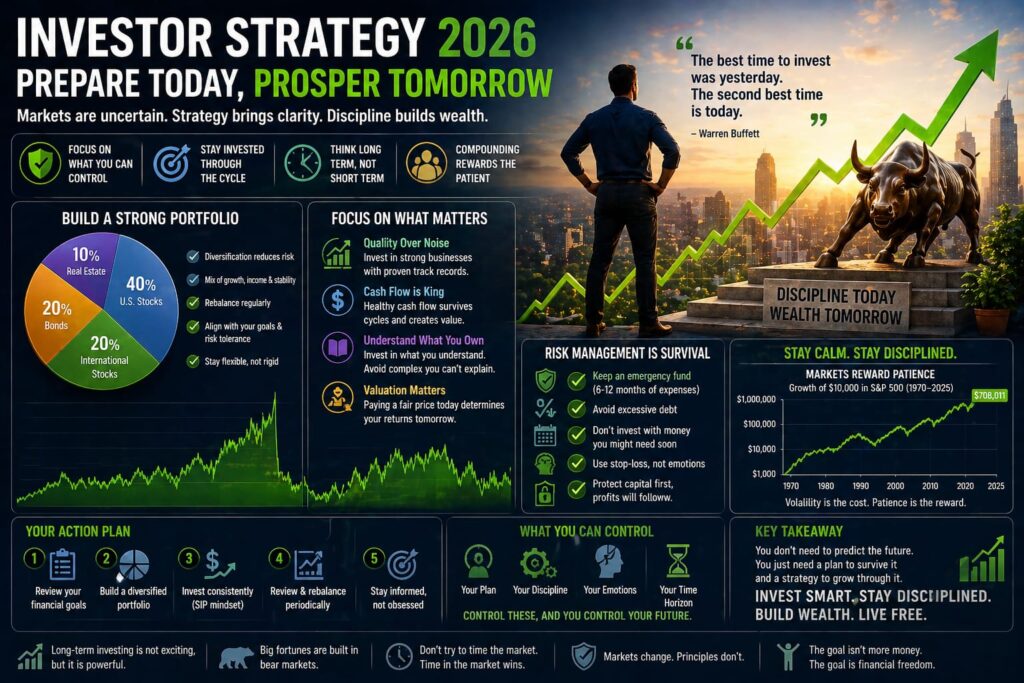
🧠 WHAT SMART INVESTORS ARE DOING
This is where the real advantage is built.
—
🛡️ 1. Diversification Is Non-Negotiable
Smart investors are spreading risk:
– Growth + defensive sectors
– Domestic + international exposure
—
💵 2. Holding Strategic Cash
Not fully invested.
Why?
– To handle volatility
– To deploy during corrections
—
🏢 3. Focusing on Quality
They prioritize companies with:
– Strong balance sheets
– Consistent cash flow
– Market leadership
Examples include:
–
–
—
⏳ 4. Playing the Long-Term Game
They understand:
«Short-term = noise
Long-term = wealth»
—
⚖️ 5. Risk Management Over Prediction
They don’t try to guess the market.
They prepare for outcomes.
—
👉 Core mindset:
«“Control risk first. Capture upside second.”»
—
💣 FINAL TRUTH OF STEP 4
– Crash is possible ✔
– Crash is not certain ❌
– Opportunity exists in both cases ✔
⚠️ FINAL VERDICT — WHAT THIS REALLY MEANS FOR INVESTORS
You’ve seen the data.
You’ve seen the comparisons.
You’ve seen the risks building beneath the surface.
Now comes the only question that actually matters:
Are we heading toward a 2008-style crash — or not?
Let’s answer that clearly.
No hype.
No fear.
No false certainty.
—
🧠 THE REALITY CHECK (WHAT MOST PEOPLE GET WRONG)
First, understand this:
Markets don’t move based on certainty.
They move based on probability.
And right now, the probability landscape looks like this:
– Strong system ✔
– Rising pressure ⚠️
– Multiple risk factors building ⏳
That combination doesn’t guarantee a crash.
But it doesn’t eliminate the possibility either.
—
Here’s the uncomfortable truth…
The biggest losses in markets don’t happen because people didn’t have data.
They happen because people ignored what the data was quietly saying.
—
⚖️ THE DIRECT ANSWER (NO CONFUSION)
❓ Is a 2008-style crash coming?
👉 An exact repeat of 2008 is unlikely.
Because today:
– Banks are significantly better capitalized
– Regulations are stronger
– Risk is more distributed across the system
This is not the same fragile structure that existed before the .
—
❓ But can the market still fall hard?
👉 Yes — and that risk is real.
Because current conditions include:
– Record debt levels
– Elevated valuations
– Tight liquidity
– Sensitivity to external shocks
—
👉 Final clarity:
«The system is not broken…
but it is under pressure.»
—
💣 WHAT THIS MEANS FOR YOUR MONEY
This is where most investors go wrong.
They try to predict.
Instead of preparing.
—
🚫 1. Don’t Panic Sell
Market declines are normal.
But panic turns temporary volatility into permanent loss.
—
⚠️ 2. Don’t Assume “This Time Is Different”
Every cycle feels different.
Until it behaves the same.
Stay grounded in data — not narratives.
—
🧠 3. Think in Scenarios, Not Predictions
Instead of asking:
«“Will the market crash?”»
Ask:
«“What will I do if it does?”»
—
💵 4. Build a Strategy That Survives Both Outcomes
In uncertain markets:
– Diversification matters
– Liquidity matters
– Risk management matters
More than ever.
—
⏳ 5. Understand the Long-Term Game
Short-term:
👉 unpredictable
Long-term:
👉 wealth-building
—
The investors who win aren’t the ones who predict perfectly…
They’re the ones who stay disciplined when it matters most.
—
📊 FINAL MARKET TRUTH (THE ONE LINE THAT MATTERS)
A crash is a risk.
But it’s also an opportunity — depending on how prepared you are.
—
❓ FAQ — WHAT INVESTORS ARE ASKING RIGHT NOW
Q1: Will the US stock market crash in 2026?
👉 A correction or increased volatility is likely. A full crash is possible but not the base-case expectation.
—
Q2: Is this similar to 2008?
👉 There are similarities, but the system today is structurally stronger and more regulated.
—
Q3: Should I sell my stocks right now?
👉 Decisions should be strategy-based, not emotion-driven. Panic selling often leads to losses.
—
Q4: Where should I invest during uncertainty?
👉 Focus on diversification, quality companies, and maintaining liquidity for opportunities.
—
Q5: Is a recession coming?
👉 Indicators are mixed. A slowdown is possible, but a severe recession is not guaranteed.
—
🏁 FINAL CLOSING — THE PART YOU SHOULD REMEMBER
Markets don’t just test strategies.
They test psychology.
They test discipline.
They test patience.
They test conviction.
And in times like this:
– Some investors panic
– Some step aside
– And a small group quietly positions themselves
—
Right now, the market is not clearly bullish.
It’s not clearly bearish either.
It’s a transition phase.
And transition phases…
are where wealth is either built — or lost.